The story
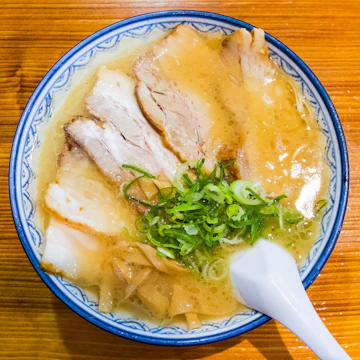
In 1937 Tokio Miyamoto opened a ramen stall called Nankin Senryo on a street in Kurume, a city in southern Fukuoka Prefecture. Inspired by Chinese-style noodle soups, he built his broth on pork bones, which were cheaper than chicken. The famous milky look came ten years later, in 1947, when Katsumi Sugino of the Sankyu stall reportedly left his pot boiling hard while he was away and found the soup had turned creamy white. The style spread to Hakata in nearby Fukuoka city and across Kyushu, and Hakata ramen later carried it worldwide.
Rival claims
Hakata, in Fukuoka city, where pork-bone ramen stalls opened from the mid-1940s, is far better known for the style and some argue it developed its own version, but Kurume's 1937 stall and its 1947 milky broth are generally credited as the origin.
Also known as tonkotsu, pork bone ramen, Kurume ramen, Hakata ramen.
On the Meridish menu
Tonkotsu ramen was the soup course on menu No. 7 on October 7, 2026. Its clue in the game, which hints at the place without naming it:
Pork-bone broth boiled until it turns milky. It's traced to street stalls in this small city, before it spread to its big neighbor.
In Meridish, every dish is pinned to the town or city most widely credited with creating it. A guess within 25 km scores all 100 points. How scoring works.
Sources
- crossroadfukuoka.jp/en/articles/kurume-ramen
- welcome-kurume.com/en/enjoys/gourmet/foods_01.html
- fukuoka-now.com/en/rwc/deep-fukuoka/tonkotsu-ramen
- en.wikipedia.org/wiki/Tonkotsu_ramen
Food history is often disputed. Think we've pinned it in the wrong place? Tell us at hello@meridish.com, ideally with a source.