The story
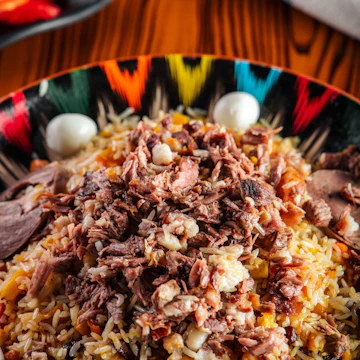
Rice cooked with meat has ancient roots across Persia and Central Asia, and plov is the Central Asian branch of the pilaf family. Legends credit Alexander the Great's cooks at Samarkand or the physician Avicenna in Bukhara, but no one can pin down the first pot. In Uzbekistan it became the national dish, cooked in huge cast-iron kazans for weddings, holidays and gatherings, with proud regional styles from Samarkand, Bukhara, Fergana and the capital, Tashkent, whose version is known as wedding plov. In 2016 UNESCO recognised Uzbekistan's plov culture as intangible heritage.
Rival claims
Plov belongs to the wider pilaf family that began in Persia, and Tajikistan shares it (its oshi palav was added to UNESCO's list the same year). Legends credit Samarkand (Alexander the Great's cooks) or Bukhara (Avicenna); no source names Tashkent as the birthplace, so the pin is a reasonable representative spot for Uzbek plov rather than a documented hometown.
Also known as osh, palov, pilaf, Uzbek plov, oshi palav.
On the Meridish menu
Plov was the rice & noodles course on menu No. 6 on October 6, 2026. Its clue in the game, which hints at the place without naming it:
Rice, carrots and lamb cooked in a giant cast-iron kazan. In 2016 UNESCO added this country's plov culture to its list of intangible cultural heritage.
In Meridish, every dish is pinned to the town or city most widely credited with creating it. A guess within 25 km scores all 100 points. How scoring works.
Sources
- ich.unesco.org/en/RL/palov-culture-and-tradition-01166
- nationalgeographic.com/travel/article/everything-you-need-to-know-about-plov
- en.wikipedia.org/wiki/Uzbek_plov
Food history is often disputed. Think we've pinned it in the wrong place? Tell us at hello@meridish.com, ideally with a source.