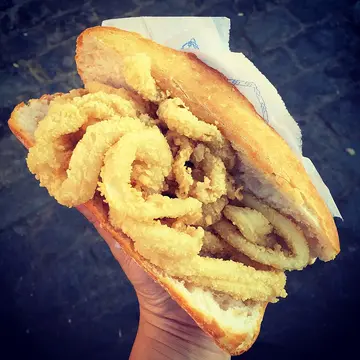
The story
Fish reached landlocked Madrid from the 1500s, but seafood only became an everyday food after railways arrived in the mid-1800s, bringing fresh catches overnight from the coasts. Andalusian tavern keepers, skilled at batter-frying, helped make fried squid a bar-counter favourite, and at some point it went into a split roll. The bars in the narrow streets around the Plaza Mayor, such as La Campana on Calle Botoneras, turned the cheap, filling sandwich into a Madrid ritual, and El Brillante near Atocha station, which opened in the 1950s, made it famous. Today Madrid has bar routes dedicated to it, and Zaragoza adds a spicy sauce.
Also known as bocata de calamares, calamari sandwich, squid sandwich, bocadillo de calamares madrileño.
On the Meridish menu
Bocadillo de calamares was the street food course on menu No. 23 on October 23, 2026. Its clue in the game, which hints at the place without naming it:
Rings of fried squid stuffed into a crusty roll, oddly beloved in a capital far from the sea. The bars around its grand arcaded main square are famous for it.
In Meridish, every dish is pinned to the town or city most widely credited with creating it. A guess within 25 km scores all 100 points. How scoring works.
Sources
Food history is often disputed. Think we've pinned it in the wrong place? Tell us at hello@meridish.com, ideally with a source.