The story
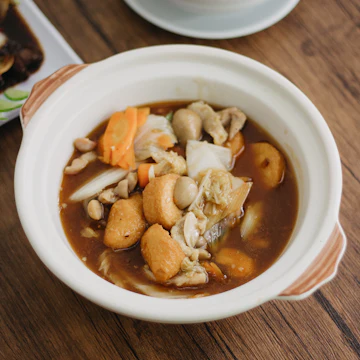
Bak kut teh means 'meat bone tea' in Hokkien, usually explained by the strong Chinese tea drunk alongside it, though Klang folklore says the 'teh' honours a cook named Lee Boon Teh. In Malaysia, the royal town of Klang is widely held to be its home. One story says Chinese coolies at the nearby port, then called Port Swettenham, boiled pork ribs with herbs and spices for strength in the early 1900s. Another credits Lee, a Fujian immigrant who sold it near Klang station in the 1940s. Singapore developed a peppery Teochew version, and the two still argue over who was first.
Rival claims
Singapore also claims bak kut teh, with a lighter, peppery Teochew version sold near the Singapore River after the Second World War. Klang's claim rests on Hokkien immigrants: stories of coolies at Port Swettenham (now Port Klang) in the early 1900s, and Lee Boon Teh's stall near Klang station in the 1940s.
Also known as bah kut teh, pork rib tea soup, Klang bak kut teh.
On the Meridish menu
Bak kut teh was the soup course on menu No. 5 on October 5, 2026. Its clue in the game, which hints at the place without naming it:
Pork ribs simmered in a dark broth of herbs and spices, said to have fortified dockworkers at this town's nearby port.
In Meridish, every dish is pinned to the town or city most widely credited with creating it. A guess within 25 km scores all 100 points. How scoring works.
Sources
- timeout.com/kuala-lumpur/restaurants/guide-to-bak-kut-teh
- thestar.com.my/news/nation/2016/08/31/the-man-who-put-teh-in-bak-kut-teh
- en.wikipedia.org/wiki/Bak_kut_teh
Food history is often disputed. Think we've pinned it in the wrong place? Tell us at hello@meridish.com, ideally with a source.