The story
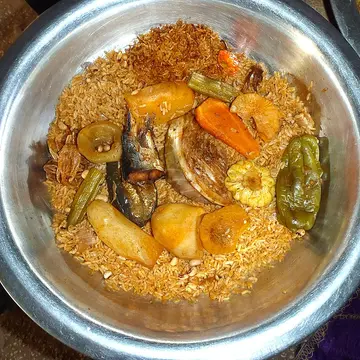
Thieboudienne, ceebu jën in Wolof, simply means 'rice and fish', and it is Senegal's national dish. It is credited to Saint-Louis, the old colonial capital on an island at the mouth of the Senegal River, in the 19th century. Local tradition names Penda Mbaye, a cook from the fishing quarter of Guet Ndar, as its creator, though historians say her exact role cannot be proven. Fish stuffed with parsley, garlic and chilli is simmered with vegetables in a tomato sauce that then cooks the broken rice. Jollof rice is thought to descend from it, and UNESCO recognised the culinary art of ceebu jën as cultural heritage in 2021.
Rival claims
Commonly credited to Penda Mbaye, a cook from Guet Ndar in Saint-Louis; historians say her role can't be proven. Note: the game's Jollof rice pin (Senegal) is only ~50 km away.
Also known as ceebu jën, thiéboudiène, thieb, tiep bou dien, riz au poisson.
On the Meridish menu
Thieboudienne (ceebu jën) was the rice & noodles course on menu No. 32 on November 1, 2026. Its clue in the game, which hints at the place without naming it:
Fish stuffed with parsley and chilli, then broken rice cooked in its tomato and vegetable sauce. Credited to a 19th-century cook in this old colonial capital at a river mouth.
In Meridish, every dish is pinned to the town or city most widely credited with creating it. A guess within 25 km scores all 100 points. How scoring works.
Sources
- en.wikipedia.org/wiki/Thieboudienne
- au-senegal.com/le-saviez-vous-12-choses-etonnantes-que-vous-ne-saviez-peut-etre-pas-sur-le-senegal,18526.html
Food history is often disputed. Think we've pinned it in the wrong place? Tell us at hello@meridish.com, ideally with a source.