The story
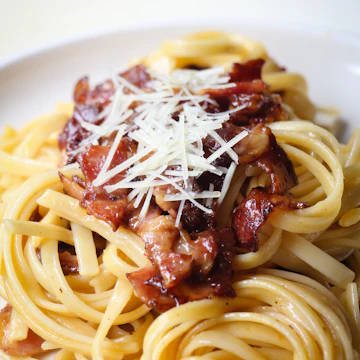
Carbonara is younger than most Roman classics. A 1939 Dutch-language newspaper article mentions 'spaghetti alla carbonara' at a trattoria in Trastevere, and in 1950 an Italian paper noted that American officers had long been seeking it out there. The first printed recipes, from Chicago in 1952 and Italy in 1954, used pancetta or bacon, garlic and even Gruyère. One popular theory links the dish to Allied rations of bacon and powdered egg; another, now largely dismissed, to charcoal burners in the hills. Over the following decades Rome settled on guanciale, eggs, pecorino and pepper.
Rival claims
Rome (Trastevere) is the accepted home, but there are rival theories: an Italian army cook, Renato Gualandi, said he devised it for Allied officers in Riccione in 1944, and an older, now largely dismissed story links it to charcoal burners (carbonari) in the Apennines of Lazio and Abruzzo.
Also known as spaghetti carbonara, spaghetti alla carbonara, pasta carbonara.
On the Meridish menu
Carbonara was the rice & noodles course on menu No. 3 on October 3, 2026. Its clue in the game, which hints at the place without naming it:
Pasta with guanciale, egg yolk, pecorino and black pepper, and no cream. Its first printed recipes date from the early 1950s.
In Meridish, every dish is pinned to the town or city most widely credited with creating it. A guess within 25 km scores all 100 points. How scoring works.
Sources
- ilpost.it/2026/02/16/carbonara-attestazione-americani
- scattidigusto.it/storia-della-carbonara-data-certa-1939-roma
- gamberorossointernational.com/?p=311317
- en.wikipedia.org/wiki/Carbonara
Food history is often disputed. Think we've pinned it in the wrong place? Tell us at hello@meridish.com, ideally with a source.