The story
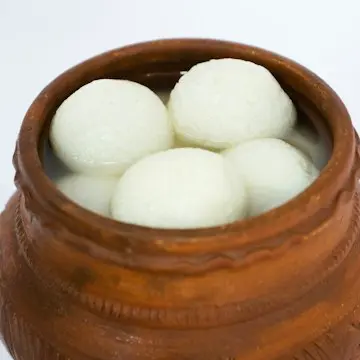
The spongy white rasgulla most people know is usually credited to Nobin Chandra Das, a confectioner who began making it in 1868 at his shop in Bagbazar, in north Kolkata, boiling balls of chhena, a fresh curd cheese, in light sugar syrup. Others in Bengal may have made something similar first, but his family popularised it, and his son's vacuum-packed cans in the 1930s carried it far beyond the city. Odisha tells a different story: rasagola has long been offered to the goddess Lakshmi at the Jagannath Temple in Puri, a tradition scholars there trace back centuries. Both states now hold separate GI tags.
Rival claims
Odisha says the sweet began centuries earlier as an offering at the Jagannath Temple in Puri; both states received separate GI tags (West Bengal 2017, Odisha 2019).
Also known as rosogolla, rasagola, rasagulla, roshogolla, rasbhari.
On the Meridish menu
Rasgulla was the dessert course on menu No. 18 on October 18, 2026. Its clue in the game, which hints at the place without naming it:
Spongy cheese balls soaked in light sugar syrup. A confectioner here made them famous in 1868, though a temple town down the coast says it offered them to its gods centuries earlier.
In Meridish, every dish is pinned to the town or city most widely credited with creating it. A guess within 25 km scores all 100 points. How scoring works.
Sources
- en.wikipedia.org/wiki/Rasgulla
- gulfnews.com/world/asia/india/west-bengal-odisha-in-bittersweet-battle-over-invention-of-rasgulla-1.1561302
Food history is often disputed. Think we've pinned it in the wrong place? Tell us at hello@meridish.com, ideally with a source.