The story
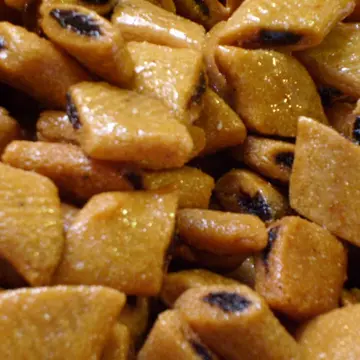
Makroudh is made across the Maghreb, but Kairouan, the ancient holy city of central Tunisia, is its best-known home. Tunisian accounts root it in the 9th-century Aghlabid era, when Kairouan was a capital, and the oldest surviving recipe for date-filled fried dough appears in a 13th-century cookbook by the Andalusian writer Ibn Razin al-Tujibi. Local lore says the diamond shape copies the geometric patterns of the city's Great Mosque. Semolina dough made with olive oil is wrapped around date paste, fried and dipped in honey or syrup. Algeria claims origins of its own, in the Mzab oases or Sétif, and Kairouan held its first makroudh festival in 2008.
Rival claims
Popular across the Maghreb; some sources place its origin in Algeria (the Mzab oases or Sétif), but this city is the most commonly named home and holds a makroudh festival.
Also known as makrout, makroud, maqrud, مقروض.
On the Meridish menu
Makroudh was the dessert course on menu No. 22 on October 22, 2026. Its clue in the game, which hints at the place without naming it:
Diamond-shaped semolina pastries stuffed with dates, fried and dipped in honey. Their shape is said to echo the patterns of this holy city's great mosque.
In Meridish, every dish is pinned to the town or city most widely credited with creating it. A guess within 25 km scores all 100 points. How scoring works.
Sources
- en.wikipedia.org/wiki/Makroudh
- fr.allafrica.com/stories/202603160575.html
- webmanagercenter.com/2012/07/01/121702/portrait-tunisie-el-hadj-ahmed-ben-soukrana-l-artisan-du-makroudh-kairouanais
Food history is often disputed. Think we've pinned it in the wrong place? Tell us at hello@meridish.com, ideally with a source.