The story
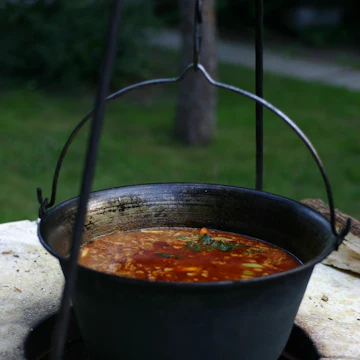
Goulash takes its name from the gulyás, the herdsmen who drove grey cattle across the Great Hungarian Plain. Cooking in iron kettles over open fires, they stewed beef with onions, and some accounts say they dried the cooked meat to carry on long drives. Paprika, from peppers that reached Hungary during the Ottoman era, joined the pot around the end of the 18th century and gave the dish its red color. In the 1800s Hungarian nationalists embraced the herdsmen's stew as a symbol of the nation, and from Budapest's restaurants it spread across Europe.
Rival claims
No town has a real claim: goulash grew out of the cauldron cooking of cattle herders across the Great Hungarian Plain (the puszta), and Budapest only popularised it as a national dish in the 19th century. Hortobagy and the Kiskunsag are often named as classic herding country.
Also known as gulyás, gulyásleves, Hungarian goulash, goulash soup.
On the Meridish menu
Goulash (gulyás) was the soup course on menu No. 2 on October 2, 2026. Its clue in the game, which hints at the place without naming it:
Cattle herders on this country's vast grassy plain stewed beef and onions in kettles over open fires. Paprika came later and made it famous.
In Meridish, every dish is pinned to the town or city most widely credited with creating it. A guess within 25 km scores all 100 points. How scoring works.
Sources
- smithsonianmag.com/travel/goulash-origins-food-history-atlas-of-eating-soup-smithsonian-journeys-travel-quarterly-danube-180958690
- en.wikipedia.org/wiki/Guly%C3%A1sleves
- theculturetrip.com/europe/hungary/articles/a-brief-history-of-hungarian-goulash
- hungarytoday.hu/szolnok-goulash-festival-awaits-lovers-of-traditional-cuisine
Food history is often disputed. Think we've pinned it in the wrong place? Tell us at hello@meridish.com, ideally with a source.